
Hyena Habitat: A Deep Dive into the Spotted Hyena Ecosystem, Lions vs. Hyena Battles, and Safari Guide
The spotted hyena habitat spans some of the most dynamic, harsh, and resource-rich landscapes on the African continent. Long misunderstood as mere opportunistic scavengers, spotted hyenas (Crocuta crocuta) are, in reality, highly sophisticated apex predators whose social structures, physical endurance, and environmental adaptability make them one of Africa’s most successful carnivores.
From the vast, rolling short-grass plains of the Serengeti to the acacia-dotted hills of the Masai Mara, understanding the spotted hyena habitat reveals how these animals dominate their ecosystems. It also illuminates their eternal, high-stakes rivalry with African lions—a brutal dynamic that shapes predator ecology across East Africa.
1. Understanding the Spotted Hyena (Crocuta crocuta)
To understand the spotted hyena habitat, one must first understand the creature that inhabits it. Despite their dog-like appearance, hyenas are feliforms—meaning they are more closely related to cats, civets, and mongooses than to canines.
Evolutionary Success & Physical Adaptations
The spotted hyena is the largest member of the family Hyaenidae. Females are noticeably larger and more muscular than males, weighing up to 80 kg (175 lbs) in East and Southern Africa, whereas males rarely exceed 60 kg (132 lbs).
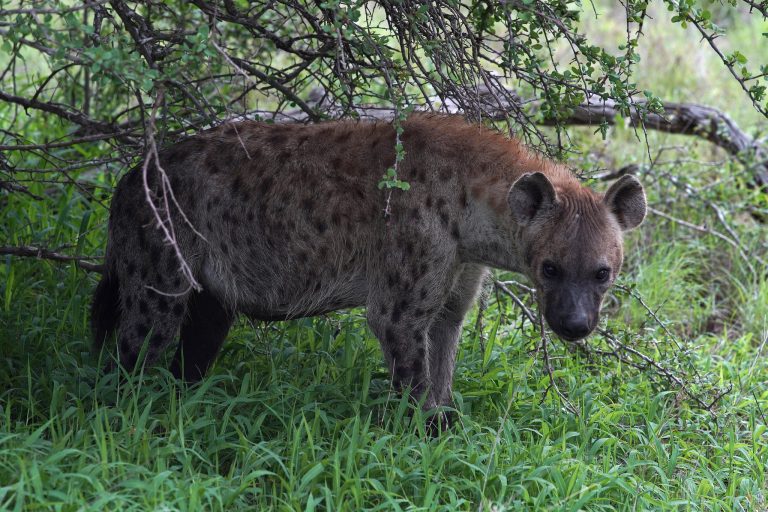
- Bone-Crushing Jaw Mechanics: A spotted hyena’s jaw exerts a bite force exceeding 1,100 psi (pounds per square inch). This force allows them to crack open thick marrow-filled long bones of buffalo and giraffes that lions leave behind.
- Cardiovascular Stamina: Hyenas possess an extraordinarily large heart relative to their body mass—nearly double the relative size of a lion’s heart. Combined with a complex vascular network in their elongated muzzles that acts as an air-cooling exchanger, hyenas can maintain pursuit speeds of up to 50–60 km/h (30–37 mph) over distances exceeding 5 kilometers.
- Digestive Systems of Steel: Their stomach acid is remarkably potent (pH < 2), enabling them to digest bones, skin, teeth, and horns.
Matriarchal Clan Dynamics
Spotted hyena social organization is among the most complex outside of primates. They live in fission-fusion societies known as clans, which can number anywhere from 15 to over 100 individuals depending on prey availability.
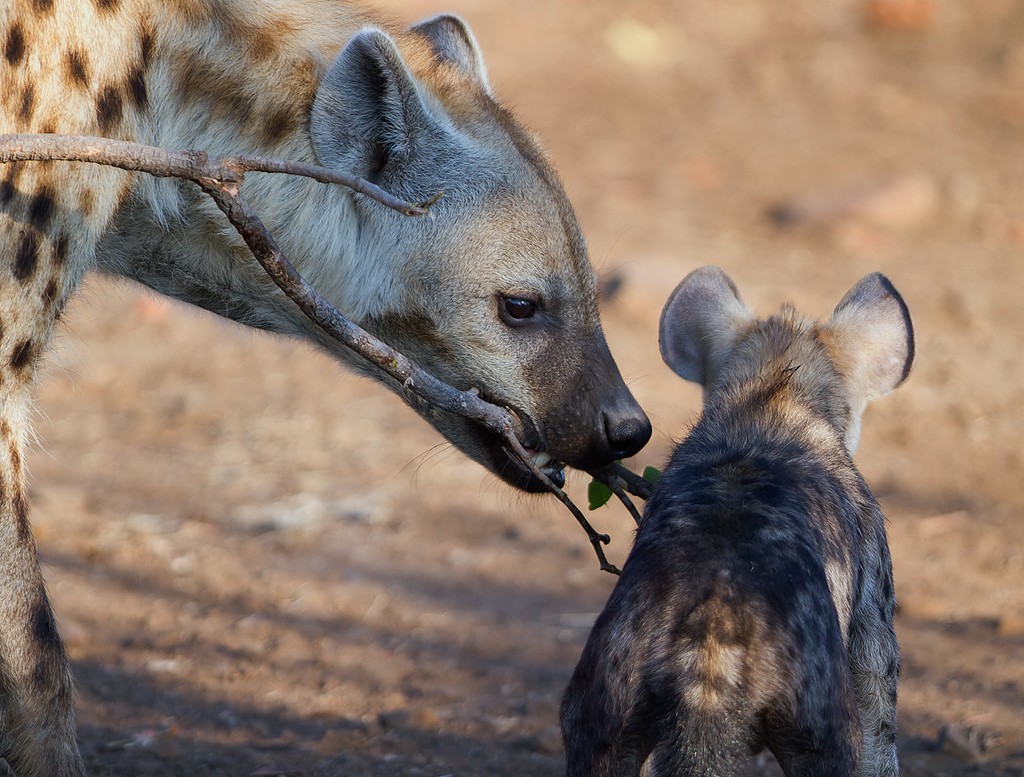
Key Rule of Clan Life: The spotted hyena society is strictly matriarchal. Every single female ranks above every male in the clan hierarchy. The lowest-ranking adult female outranks the highest-ranking alpha male. Female cubs inherit their mother’s rank, maintaining matrilineal dynasties that can endure for generations.
Defining the Spotted Hyena Habitat
When wild animal researchers evaluate the spotted hyena habitat, they observe a species capable of thriving in virtually any landscape where prey exists, provided extreme canopy cover or complete waterless hyper-deserts do not block them.
| Optimal Habitats | Marginal Habitats | Excluded Habitats |
|---|---|---|
|
• Open Savanna Grasslands • Acacia Woodlands • Floodplains & Valleys |
• Semi-Arid Scrublands • Montane Regions (>4000m) • Urban Fringes & Agricultural Areas |
• Dense Rainforest • Hyper-Arid Dunes |
Geographic Range & Biomes
Historically distributed across almost all of sub-Saharan Africa and stretching into parts of Europe and Asia during the Pleistocene, the current spotted hyena habitat is predominantly restricted to sub-Saharan Africa. Populations are densest in East Africa's protected conservation areas and Southern Africa's major game parks.
This is the primary spotted hyena habitat. Environments like the Serengeti Plain (Tanzania) and Masai Mara (Kenya) provide visibility for coursing prey over long distances and abundant ungulate populations.
Open woodland regions offer cover for denning while keeping visibility open enough for coordinated group hunting.
Hyenas thrive in dry habitats like the Kalahari Desert and Namib borderlands, relying on moisture from prey blood and melon species when water holes dry up.
Spotted hyenas have been recorded at elevations up to 4,100 meters (13,500 feet) in Mount Kenya, Aberdare Range, and Mount Kilimanjaro.
Environmental Exclusions
Spotted hyenas avoid two primary terrestrial biomes:
Deep Tropical Rainforests
The dense canopy of the Congo Basin prevents effective long-distance coursing, making it impossible for their hunting style to succeed.
Hyper-Arid Sand Dunes
Areas lacking ungulate populations or reachable water sources, such as the core sand seas of the Sahara and Namib, cannot sustain clan structures.
Key Features of a Successful Hyena Territory
A viable spotted hyena habitat territory must fulfill three essential requirements:
Soil conditions suitable for digging or existing subterranean structures (like disused aardvark holes).
While resilient, hyenas need water to cool down after endurance hunts and drink regularly during hot seasons.
A high biomass of medium-to-large ungulates (wildebeest, zebra, gazelle, topi, buffalo).
Micro-Habitats: Denning Systems and Territorial Marking
Within the broader spotted hyena habitat, the communal den is the social, structural, and reproductive focal point of the clan.
The Architecture of the Communal Den
Unlike lion prides, which park cubs in thickets, hyenas rear their offspring underground.
Dens are usually constructed from converted aardvark burrows, warthog holes, or natural rock crevices. The tunnels are enlarged underneath, but the entrances are kept intentionally narrow.
The main opening is small enough to permit hyena cubs to slide inside while blocking larger apex predators—most notably adult male lions—from entering to kill the young.
A single communal den can hold dozens of cubs from different females within the clan. High-ranking females occupy the central den core, while lower-ranking mothers raise young along the outer fringes or in satellite dens.
Scent Marking & Boundary Patrols
Territorial boundaries within a spotted hyena habitat are clearly demarcated using sophisticated chemical communication:
Hyenas possess an anal pouch that secretes a pungent, greasy substance called "hyena butter." They rub this scent onto grass stalks along territory edges.
Clans maintain shared latrine sites strategically positioned near boundary lines. These serve as visual and olfactory markers to rival clans.
Groups of clan members regularly march in formation along territory boundaries, actively chasing off or killing intruding rival hyenas.
4. The War Zone: Lions vs. Spotted Hyenas in the Masai Mara & Serengeti
Nowhere on Earth is the spotted hyena habitat more contested than in the contiguous Serengeti-Mara Ecosystem. Covering over 30,000 square kilometers across Tanzania and Kenya, this expanse sets the stage for one of nature’s most violent interspecific rivalries.
The Roots of Conflict: Apex Niche Overlap
Lions (Panthera leo) and spotted hyenas (Crocuta crocuta) share nearly 60–80% of their ecological niche in East Africa. Both target the same primary prey species:
Contrary to popular historic myth, spotted hyenas do not survive primarily on lion leftovers. Modern field research reveals that spotted hyenas kill between 65% and 95% of the food they consume. In fact, in regions like the Serengeti plains and Ngorongoro Crater, lions scavenge from hyena kills far more frequently than hyenas scavenge from lions.
Tactical Breakdown: Size vs. Numbers
When a kill occurs in the spotted hyena habitat of the Masai Mara or Serengeti, a battle for possession almost always follows. The outcome depends on a clear mathematical formula based on physical weight, gender, and individual count.
| Factor | Ecological Impact & Outcome |
|---|---|
| The 4-to-1 Ratio Rule | Hyenas need roughly 4 to 5 adult hyenas per female lion to force her off a carcass. |
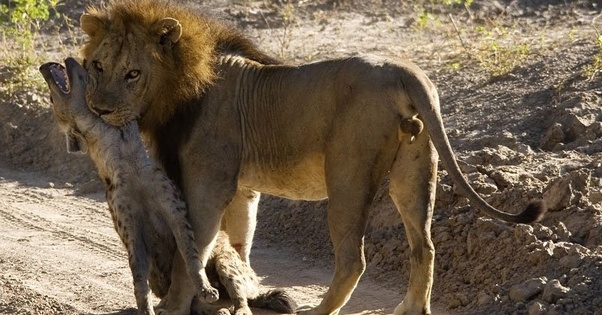
| The Male Lion Factor | A single adult male lion disrupts the ratio; hyenas will rarely attack if a male is present. |
| Night Operations | Hyenas gain tactical advantage in dark conditions through vocal call-outs ("cackles/whoops"). |
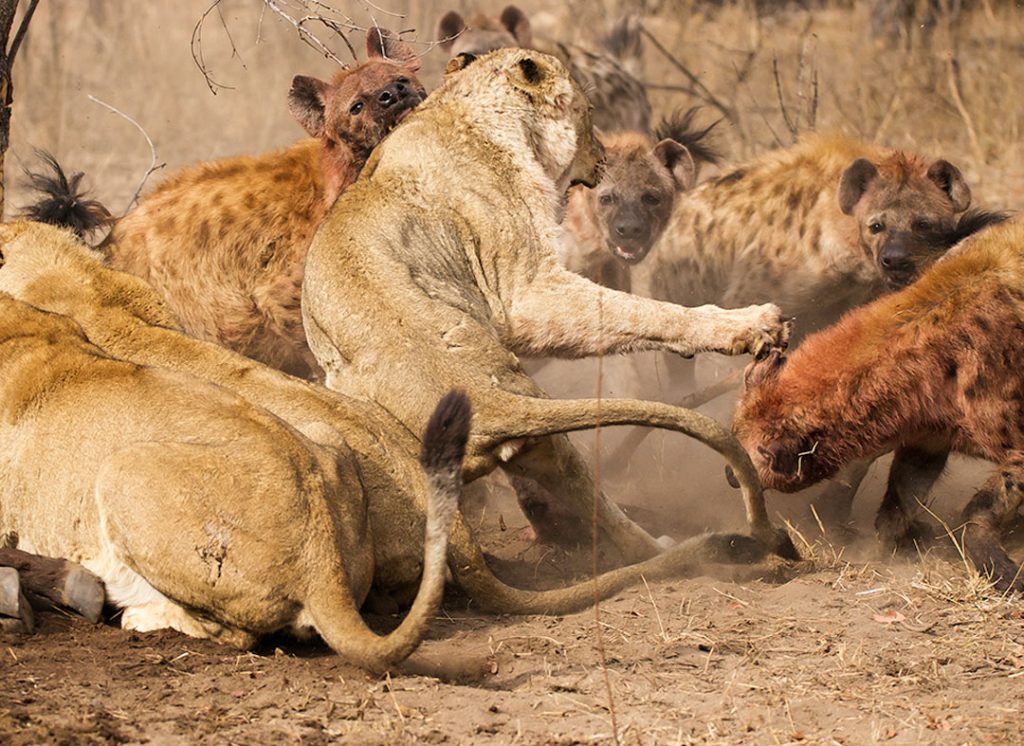
An adult female lion weighs roughly 120–150 kg (260–330 lbs), while an adult female hyena weighs 60–80 kg (130–175 lbs). Because of this size disparity, a single lioness can easily overpower individual hyenas. However, if hyenas assemble a local numerical superiority of 4 to 5 hyenas per female lion, they can mob the lionesses, nipping at their flanks until the lions abandon the carcass.
The presence of a full-grown adult male lion completely changes this balance. Weighing 190–225 kg (420–500 lbs), an adult male lion possesses enough muscle, speed, and jaw strength to crush a hyena's spine or skull with a single bite.
Under the cover of night, hyenas use complex vocalizations to summon reinforcements across vast distances within their habitat:
- The "Whoop": A long-distance contact call that can travel over 5 km, signaling clan members to assemble at a specific location.
- The "Giggle/Cackle": Indicates stress, excitement, or confrontation—often voiced when mobbing lions at a kill site.
When a fight breaks out, the sound of laughing hyenas and roaring lions echoes across the Mara plains for miles, signaling to safari guide vehicles that a territorial battle is taking place.
Famous Conflict Hotspots in the Mara-Serengeti
- Paradise Plains & Musiara Swamp (Masai Mara): Home to the famous Marsh Pride of lions and large resident hyena clans. Thick scrub and tall grass create high-tension ambush encounters.
- Seronera Valley (Central Serengeti): Rich riverine habitat where lion pride territories overlap with multiple hyena clans.
- Ngorongoro Crater (Tanzania): A high-density caldera habitat where hyena populations outnumber lions by roughly 6 to 1, leading to frequent intense conflicts over wildebeest kills.
5. Ultimate Safari Itinerary: Witnessing the Predator War Live
To witness live lion vs. hyena interactions in their natural habitat, travelers must time their trip with the Great Migration and base themselves in high-density predator territories.
Best Time to Visit for Action
Peak Migration season in Northern Serengeti and Masai Mara. Maximum herbivore concentration triggers intense predator-on-predator competition.
Southern Serengeti (Ndutu) calving season. Over 8,000 wildebeest are born daily, attracting immense numbers of lions and hyenas.
Detailed 8-Day Combined Serengeti & Masai Mara Itinerary
- Morning: Pick up in Arusha; scenic drive through the Rift Valley highlands.
- Afternoon: Arrive at the rim of the Ngorongoro Crater. Afternoon nature walk along the crater rim to spot territorial scent-marking trails.
- Evening: Detailed safety briefing and dinner at the lodge overlooking the crater floor.
- Accommodation: Ngorongoro Serena Safari Lodge or crater-rim luxury tented camp.
- Full Day: Descend 600 meters into the crater floor for a full-day game drive.
- Highlight: Ngorongoro hosts one of the highest concentrations of spotted hyenas in Africa. Watch large clans hunting zebra and wildebeest in the early morning fog. Observe mobbing behaviors as hyenas defend fresh kills against resident lion pride females.
- Accommodation: Ngorongoro Crater Rim Lodge.
| Density Level | Extremely High (~400+ hyenas in 260 sq km) |
| Primary Prey | Wildebeest, Zebra, Buffalo Calves |
| Lion-Hyena Ratio | ~6 Hyenas per 1 Lion |
| Key Viewing Feature | Open caldera lake basin with zero bush cover |
- Morning: Drive northwest from Ngorongoro into the endless plains of the Serengeti.
- Afternoon: Safari drive in the Seronera River Valley. Search the granite kopjes (rock outcrops) for lion prides resting in the shade while keeping an eye out for active hyena den entrances along dry riverbanks.
- Night Experience: Late dusk drive or night talk with resident big cat researchers. Listen for the distinct calls of hyenas gathering for night hunts.
- Accommodation: Ole Serai Luxury Camp Turner Springs or Kati Kati Tented Camp.
- Morning: Early departure heading north through the Serengeti wilderness corridor.
- Afternoon: Explore the Kogatende region near the Mara River. Here, massive wildebeest herds queue up to cross the river. Lions wait along riverbank thickets while hyena packs stalk the rear of the migrating herds.
- Accommodation: Sayari Camp or Mara River Tented Camp.
- Morning: Morning game drive in Kogatende; proceed to the Isebania/Tarime border crossing into Kenya.
- Afternoon: Switch vehicles and enter the famous Masai Mara National Reserve. First afternoon game drive across the Mara savannah, tracking predator calls near water holes.
- Accommodation: Mara Serena Safari Lodge or Governor's Camp.
- Full Days: Two complete days dedicated to tracking big cat and hyena interactions in the Mara's top predator zones.
- Key Focus:
- 5:30 AM Drives: Catch hyena clans returning to their communal dens from overnight hunts. Watch cubs playing around burrow entrances.
- Mid-Day Strategy: Monitor lion kills left in river channels. Watch how hyenas wait patiently in nearby mud baths to keep cool while keeping watch on the lions.
- Late Afternoon to Dusk: Positioning near lion prides as they awaken and prepare to hunt. Watch hyenas trailing lions at a distance, waiting for an opportunity to steal a meal.
- Accommodation: Elephant Pepper Camp or Sentinel Mara Camp.
- Morning: Final sunrise game drive in the Mara to capture lasting images of hyenas on the open plains.
- Afternoon: Fly or drive back to Nairobi (Jomo Kenyatta International Airport) for your homeward flight.
Ready to Witness the Apex Predator War Live?
Experience the raw, thrilling dynamics of the Mara-Serengeti ecosystem firsthand. Book your specialized Hyena-Lion Safari with Active Uganda Safaris today and secure front-row seats to nature's most intense rivalries.
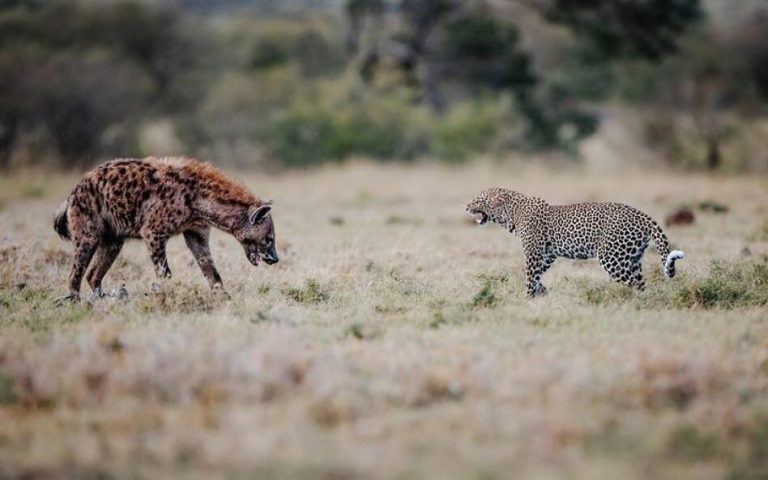
6. Comparison: Spotted Hyena vs. Other African Carnivores
To fully understand the spotted hyena habitat and their ecological role, it is helpful to compare them directly against Africa's other primary carnivores:
| Characteristic | Spotted Hyena (Crocuta crocuta) |
African Lion (Panthera leo) |
Leopard (Panthera pardus) |
Cheetah (Acinonyx jubatus) |
|---|---|---|---|---|
| Average Weight | 60 – 80 kg (Females larger) | 120 – 225 kg (Males larger) | 40 – 80 kg | 35 – 65 kg |
| Hunting Style | Long-distance endurance coursing | Short explosive ambush | Stealth stalk & pounce | High-speed sprint pursuit |
| Social Structure | Matriarchal Clan (up to 100+) | Pride (Nuclear family groups) | Solitary | Solitary / Male Coalitions |
| Bite Force | ~1,100 PSI (Can crush bone) | ~650 PSI | ~500 PSI | ~400 PSI |
| Habitat Preferences | Open savanna, woodland, semi-desert | Savanna, scrubland, open woods | Dense brush, trees, rocky hills | Open short-grass plains |
| Denning Strategy | Underground communal burrows | Hidden vegetation patches | Rocky crevices, dense thicket | Tall grass depressions |
| Ecological Role | Primary hunter & bone-recycler | Apex ambush predator | Secretive generalist predator | Specialized diurnal hunter |
7. Conservation, Human Coexistence, and Myths
Despite their ecological importance, spotted hyenas face significant conservation challenges throughout their habitat range.
Human-Wildlife Conflict
Outside protected reserves like the Serengeti and Masai Mara, human population expansion is fragmenting the spotted hyena habitat.
- Livestock Depredation: When natural ungulate populations drop, hyenas may target cattle and goats.
- Retaliatory Poisoning: Farmers often use illegal agricultural poisons on carcasses to kill entire clans, severely impacting localized hyena populations as well as vultures and other scavengers.
- Snaring: Wire snares set by poachers for bushmeat frequently catch hyenas, causing severe injury or death.
Dispelling the Myths
For centuries, African folklore and modern media portrayed hyenas negatively—labeling them cowardly, dirty, and sneaky.
-
Myth: Hyenas are hermaphrodites or can change sex at will.
Fact: Female spotted hyenas possess a pseudo-penis (elongated clitoris) and pseudo-scrotum driven by high levels of fetal androgens. While anatomically unusual, they are distinct, breeding mammalian females.
-
Myth: Hyenas are purely cowardly scavengers.
Fact: Controlled field studies show hyenas execute complex hunting strategies, taking down large prey like zebra and wildebeest through group coordination.
Support Wildlife Conservation
Help protect critical African ecosystems, reduce human-wildlife conflict, and secure a future for hyena clans in the wild.
By booking a safari, you not only protect the ecosystems of Africa, but you also support the local communities that share these ecosystems with the animals
Get Involved Today8. Summary Checklist for Wildlife Enthusiasts
When planning a trip to experience the spotted hyena habitat firsthand, keep these essential tips in mind:
Ready for Your African Safari?
Plan your journey into East Africa's prime wildlife havens with expert guides trained in carnivore tracking.
Book Your Excursion