Uganda Travel Vaccinations (Health Precautions Required for Tourists) (2026 Travel Guide)
The One Essential Entry Requirement For Travellers To Uganda
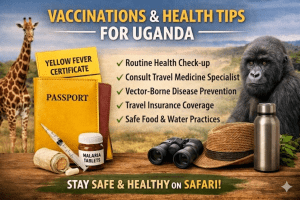
Ensure that you get your yellow fever vaccination shot at least 10 days before travel to ensure it’s valid at the border. Then, slip your Yellow Fever Vaccination Card into your passport cover—it’s the most important document you’ll carry!
Planning a safari or holiday in Uganda is an exciting experience, but before you travel, it’s essential to understand the health requirements. A common question travelers ask is: What vaccinations and health precautions are required for Uganda?
Uganda is a safe and rewarding destination, but like many tropical countries, it has specific entry health requirements and recommended precautions to keep visitors healthy during their stay.
This guide covers everything you need to know before your trip.
Frequently Asked Questions(FAQ): Uganda Health & Vaccinations required for Travelling To Uganda
Yes. All travelers entering Uganda must provide a valid Yellow Fever vaccination certificate at immigration. This is a strict entry requirement for everyone aged one year and older. You should receive the vaccine at least 10 days before your arrival.
While only Yellow Fever is mandatory, health experts strongly recommend vaccinations for Hepatitis A, Typhoid, and Tetanus. For those planning longer stays or close contact with wildlife, Hepatitis B and Rabies vaccinations are also advised.
Since Uganda is a high-risk malaria zone, taking anti-malarial medication is highly recommended. Consult your doctor for the best prescription for your needs.
You should also use insect repellent containing DEET and sleep under mosquito nets, which are provided in most safari lodges.
It is not recommended to drink tap water in Uganda. To avoid stomach upsets, stick to bottled or filtered water, which is readily available at all major hotels, lodges, and supermarkets.
It is best to consult a travel clinic or your doctor at least 4 to 8 weeks before your departure. This allows enough time for vaccinations to become effective and for you to complete any multi-dose series if required.
While medical facilities at the airport can sometimes provide the Yellow Fever vaccine for those who arrive without a certificate, it can cause significant travel delays and may result in a fine or denied entry.
It is much safer and more efficient to get vaccinated in your home country before you travel.
Mandatory Vaccinations for Uganda
Yellow Fever Vaccination (Required)
The yellow fever vaccination is mandatory for all travelers entering Uganda. You must present a valid yellow fever vaccination certificate at immigration upon arrival.
- Required for all travelers above 1 year of age
- Must be taken at least 10 days before travel
- Proof is checked at entry points
Without this certificate, you may be denied entry or required to get vaccinated on arrival.
Ready to Start Your Journey?
Your health is handled—now let us handle the rest. Explore the “Pearl of Africa” with our expert-led tours. Check out our latest affordable Uganda safaris for 2026/2027 and start planning your bucket-list wildlife encounter today!Recommended Vaccinations for Uganda
1. Rabies (Optional)
Recommended for:
- Long-term travelers
- Those visiting remote areas
- Wildlife or primate encounters
Experts strongly recommend vaccinations for Hepatitis A, Typhoid, and Tetanus. For those planning longer stays or close contact with wildlife, Hepatitis B and Rabies vaccinations are also advised.
Always consult a travel clinic or doctor 4–8 weeks before your trip for personalized advice.
Malaria Prevention in Uganda
Uganda is a malaria-risk country, so taking precautions is essential.
Recommended Measures:
- Take anti-malarial medication (as prescribed)
- Use insect repellent with DEET
- Sleep under mosquito nets (provided in most lodges)
- Wear long sleeves in the evening
Most safari lodges and camps maintain strong mosquito control measures, especially in national parks.
Food and Water Safety Tips
To avoid stomach-related illnesses:
- Drink only bottled or filtered water
- Avoid ice in drinks unless confirmed safe
- Eat well-cooked food
- Wash or sanitize hands regularly
Uganda’s top safari lodges maintain high hygiene standards, so risks are minimal when traveling with a reputable operator.
Health Tips for Safari Travelers
- Stay hydrated during game drives
- Carry sunscreen and a hat
- Pack a basic first aid kit
- Inform your guide of any medical conditions
Uganda’s tourism infrastructure is well-developed, and most safari routes have access to medical facilities if needed.
Final Answer: What Vaccinations Are Required for Uganda?
To visit Uganda, yellow fever vaccination is mandatory, while others like hepatitis A, typhoid, and tetanus are strongly recommended.
By taking simple precautions—such as malaria prevention and safe food practices—you can enjoy a safe and unforgettable safari experience.
Travel With Confidence With Active Uganda Safaris
- Every safari vehicle carries a full medical first-aid kit.
- Our guides are first-aid certified and experienced in handling travel-related health needs.
- We maintain a real-time directory of the best local medical facilities along your specific route.
Plan Your Dream Trip!
Craft your ultimate African odyssey with the help of our local specialists. With decades of collective expertise in Uganda’s wild heart, we transform your vision of the perfect wildlife adventure into a seamless, life-changing reality. Whatever your quest, our team is here to guide you every step of the way.